On the afternoon of March 12, 2026, a four-member delegation from the Tin Ka Ping Foundation, led by Executive Chairman of the Board Yuen Pong-yiu and Chief Executive Officer Bryan Tin Lap-yan, visited the Faculty of Education of Shenzhen University for research and exchange. The meeting was attended by Jin Yule, Dean of the Faculty of Education; Wu Changxian, Deputy Secretary of the Party Committee; Zhao Mingren and Li Penghu, Vice Deans; Li Shuying, Dean of the Institute of Education; Huang Juan, Executive Vice Dean of the School of Teacher Development; and other faculty representatives. The session was chaired by Zhao Mingren.
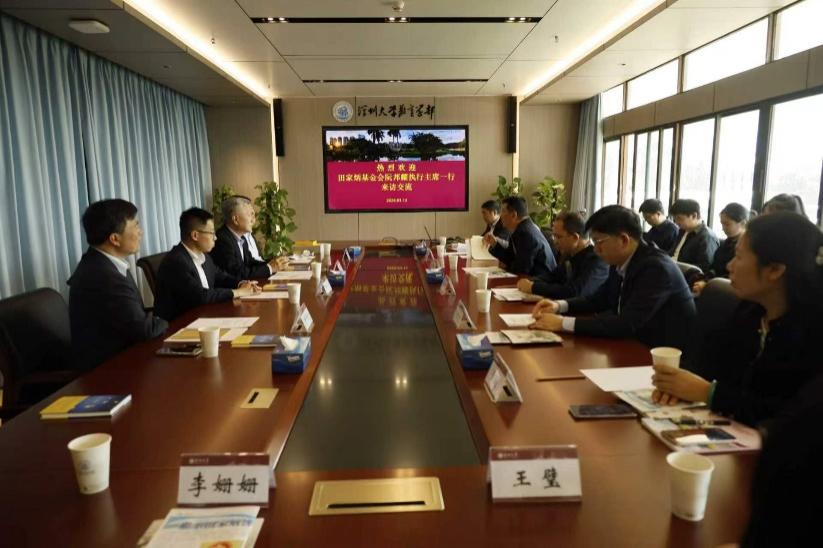
At the meeting, Jin Yule extended a warm welcome to the delegation on behalf of the Faculty of Education and introduced its development history and distinctive academic strengths. Wu Changxian expressed profound admiration for Mr Tin Ka Ping’s noble spirit of supporting education through philanthropy, and stated that the Faculty would draw inspiration from the “Tin Ka Ping Spirit” to encourage all faculty, staff and students to actively engage in educational public welfare initiatives. Li Penghu provided an overview of the Affiliated Education Group of Shenzhen University. Drawing on his own research, Li Shuying put forward collaborative ideas focused on cultivating teacher wisdom in the AI era and advancing personalized education. He emphasized that, in the context of technological empowerment, education should return to the fundamental essence of genuine teacher-student interaction.
Yuen Pong-yiu introduced the founding background of the Tin Ka Ping Foundation and its three core missions: nurturing talent, inheriting Chinese culture, and integrating world civilizations. Bryan Tin Lap-yan highlighted that the Foundation has always remained true to its educational mission, which has served as the fundamental driving force behind its continuous advancement of public welfare projects in education for decades. He encouraged faculty, staff and students of Shenzhen University to actively participate in the Foundation’s project applications and voluntary teaching programs.
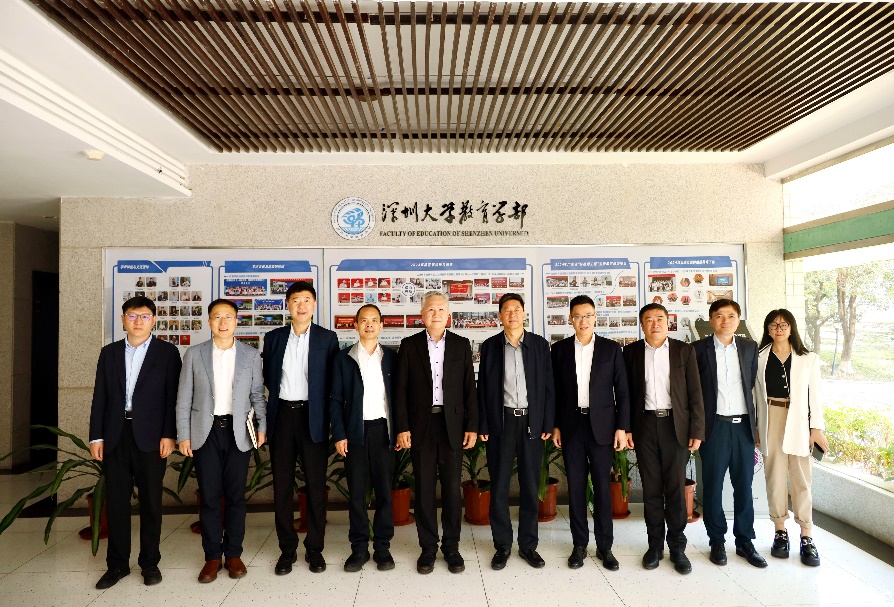
The two sides then engaged in in-depth discussions on key topics, including teacher training in the Guangdong-Hong Kong-Macao Greater Bay Area, moral education in primary and secondary schools and the inheritance of Chinese traditional culture, cross-regional student exchanges, and educational innovation in the age of artificial intelligence. Preliminary cooperation intentions were reached. This productive exchange centered on the core needs of educational development and laid a solid foundation for future collaboration between the two parties.
Written by: Xiao Baihui and Wei Hang

 Links
Links Contact us