On the morning of January 20, 2026, the Distinguished Scholar Lecture Series of the Faculty of Education was held in Conference Room A412, Huide Building. Professor Hou Huaiyin from the College of Educational Science at Shanxi University delivered a special lecture titled "The Construction of a Grand Pedagogy for the Autonomous Knowledge System of Chinese Educational Studies." The lecture was hosted by Professor Li Shuying, Dean of the Education Research Institute, Faculty of Education, Shenzhen University. Party Secretary Li Chen and Deputy Director Zhao Mingren of the Faculty were in attendance, along with relevant faculty members and students.
At the beginning of the lecture, Professor Hou Huaiyin started with the etymological meaning of the concept of "autonomy" and highlighted the historical context and urgency of constructing an autonomous knowledge system for Chinese educational studies. He pointed out that the current development of Chinese educational studies faces dual opportunities and challenges from the transformation of the global education governance landscape and the digital technology revolution. Building an autonomous knowledge system is key to enhancing international academic discourse power and serving the construction of a leading education nation.
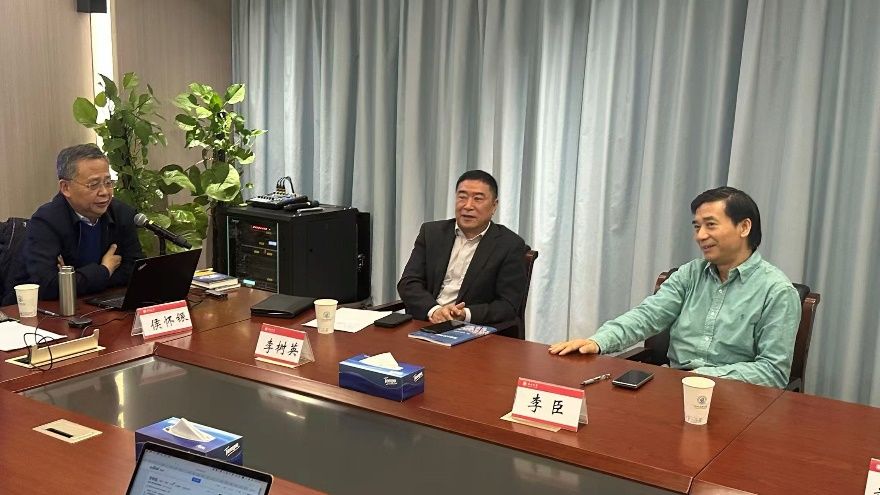
Addressing the core challenges in constructing an autonomous knowledge system for Chinese educational studies, Professor Hou Huaiyin provided an in-depth analysis of four limitations that urgently need to be overcome: first, breaking through the limitation of a knowledge system centered primarily on school education and expanding the research perspective to encompass the full spectrum of lifelong education, including preschool education, family education, community education, and elderly education; second, overcoming the imbalance in the development of knowledge systems across various sub-disciplines; third, transcending narrow disciplinary boundaries and strengthening multidisciplinary integration within educational studies as well as with the humanities, social sciences, and natural sciences; fourth, bridging the long-standing divide between theory and practice, ensuring that knowledge production is deeply rooted in Chinese educational practice. Subsequently, Professor Hou outlined four major pathways for constructing a "grand pedagogy" from the perspectives of lifelong education, an integrated disciplinary vision of grand pedagogy, the convergence of ancient and modern wisdom from China and abroad, and deep rooting in Chinese educational practice.
During the Q&A and discussion session, Professor Hou Huaiyin engaged in in-depth exchanges with the attending faculty and students on topics such as graduate student training, standards for academic paper writing, the historical evolution of naming in the discipline of education, and the distinctive development of the Faculty of Education at Shenzhen University. He suggested that the Faculty should focus on enhancing the competitiveness of key disciplines such as higher education studies, and build distinctive advantages through differentiated development by means of organized research, hosting branded academic events, and coordinating the compilation of book series.
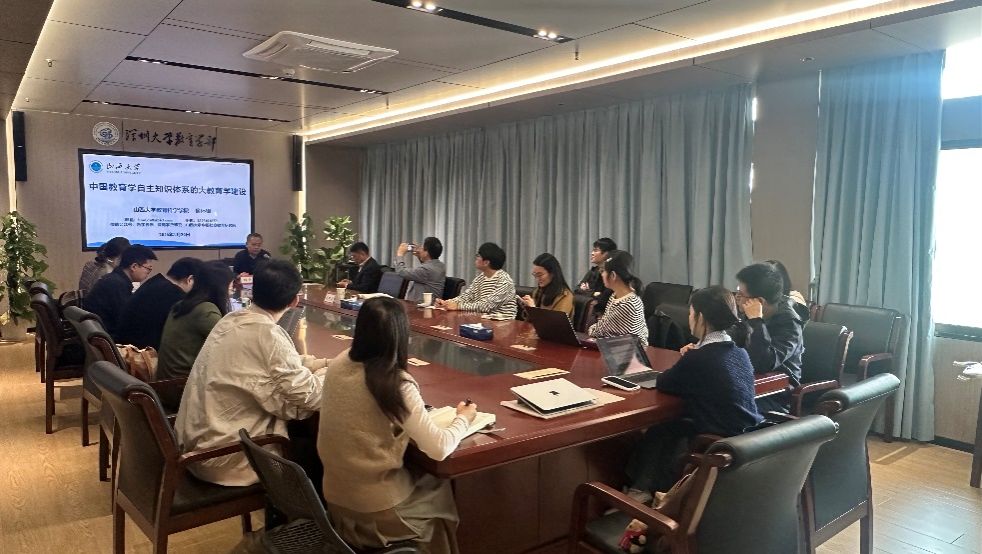
The lecture was broad in scope, rigorously logical, and combined theoretical depth with a global perspective while remaining closely connected to educational practice. Professor Hou Huaiyin's profound insights provided valuable intellectual inspiration and clear directional guidance for the attending faculty and students in understanding the autonomous innovation and future development of Chinese educational studies.
Contributors: Lin Yalan, Wei Hang
Reviewer : Li Chen

 Links
Links Contact us